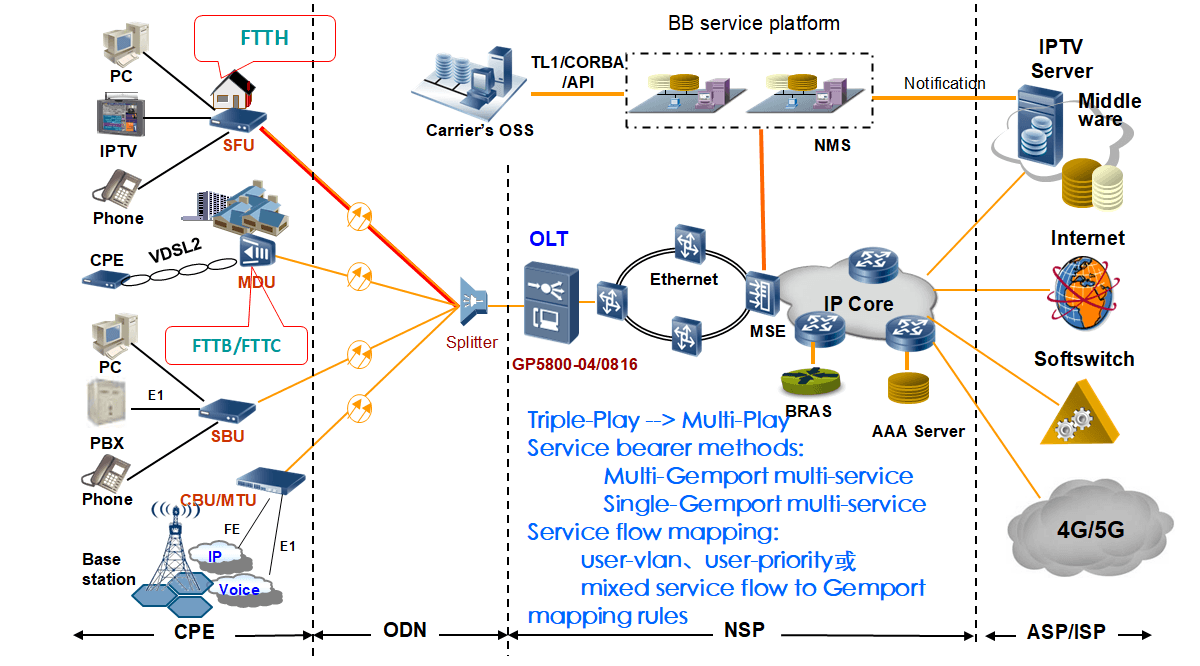
In the era of hyper-connectivity, Gigabit Passive Optical Network (GPON) has become the gold standard for delivering fiber-to-the-home (FTTH) and multi-play services. To give you a clear look at how high-bandwidth, low-latency optical networks are engineered, we refer to the structural topology blueprint as follows to dissect the underlying logic of modern fiber networks.
What is GPON and How It Works
Before exploring the architecture, we must define what is gpon technology. GPON stands for Gigabit Passive Optical Network, a broadband fiber access standard defined by the ITU-T G.984 recommendations.
So, what is gpon and how it works? In simple terms, it utilizes a Point-to-Multipoint (P2MP) architecture. In the downstream direction (from central office to users), data is broadcasted to all users, where each Optical Network Unit (ONU/ONT) filters and extracts its own packets based on a unique Gemport ID. In the upstream direction, it uses Time Division Multiple Access (TDMA), where each user device uploads data within a strictly allocated time slot to prevent collision. The "passive" aspect means there are no powered electronic components in the distribution grid, vastly cutting down maintenance costs.
The Central Hub: What is GPON OLT
At the very core of any gpon network topology, the most critical hardware is the GPON OLT (Optical Line Terminal), represented by the GP5800 series in 8d2027f104a80ef89556d4fb62c4f5c.png.
The OLT acts as the manager of the entire infrastructure, performing two primary tasks:
-
Traffic Aggregation: It consolidates incoming optical traffic from subscribers and bridges it over to the Ethernet Ring and IP Core networks, linking users to IPTV servers, the Internet, Softswitches, and 4G/5G mobile backhauls.
-
Service Mapping & Flow Control: It governs the Triple-Play to Multi-Play service transformation. By deploying Single-Gemport or Multi-Gemport service bearer methods, it accurately maps incoming user traffic to corresponding Gemports based on user-vlan or user-priority rules.
The Comprehensive GPON Network Diagram & Topology
A professional gpon network diagram breaks down the network into three distinct domains, establishing a reliable gpon network topology:
-
OLT Layer: Positioned at the carrier's Central Office (CO), managing backhaul services and authentication.
-
ODN (Optical Distribution Network):The unpowered segment comprising fiber cables and optical Splitters. A single splitter splits an optical beam into multiple streams (e.g., 1:32 or 1:64) toward end-users without requiring external power.
-
CPE Layer (Customer Premises Equipment): ONU/ONT units shaped to match specific deployment scenarios:
-
SFU (Single Family Unit): Tailored for standard residential access.
-
MDU (Multi-Dwelling Unit): Tailored for apartments or enterprises via FTTB/FTTC configurations.
-
SBU/CBU (Single/Cellular Business Unit): Tailored for corporate campuses or cellular base station backhauls.
Real-World Deployment: The GPON Home Network
The most common manifestation of this technology is the gpon home network. In a classic FTTH application, the carrier’s fiber extends through the passive splitter network right to the residential doorstep, plugging directly into an SFU / ONT (commonly called a fiber modem).
Through this streamlined mechanism, a single fiber optic thread delivers comprehensive multi-play capabilities. Homeowners can concurrently run high-speed PCs, stream 4K/8K IPTV channels, and hook up standard landline VoIP phones over the same network fabric without any signal interference—bringing an elite, seamless digital experience directly into the living room.


 Focuscom to Showcase PON and AI Workstation Solutions at CIOE 2026
 GP5801-01 Single Port GPON OLT for Compact FTTH Networks
 XPON ONU Stick: Simplify FTTH, FTTB and FTTO Network Deployment with SFP-Based PON Access
 Demystifying GPON Architecture: What is a GEM Port and Why is it Critical for FTTH Networks?
