


1. What is T-CONT?
T-CONT stands for Transmission Container. It’s not a physical object but a logical concept – a “bucket” that holds upstream data. Each T-CONT is identified by an Alloc-ID and represents a service flow with specific QoS characteristics, focusing on bandwidth guarantees rather than traditional service types (CBR, UBR, etc.).
One T-CONT can carry multiple VPs or Ports from any ONU, but each T-CONT carries only one type of data traffic.
2. Why Do We Need T-CONT?
Downstream in PON is broadcast – each ONU picks its own data. Upstream requires TDMA to avoid collisions. If the OLT allocated timeslots per ONU, an idle ONU would waste its slot while a busy ONU waits. To avoid this inefficiency, GPON allocates bandwidth per T-CONT. An ONU can have multiple T-CONTs, each serving a different traffic type.
3. What is DBA?
DBA (Dynamic Bandwidth Assignment) adjusts upstream bandwidth in microseconds or milliseconds. It uses centralized control: ONUs request bandwidth, the OLT runs an algorithm and grants timeslot grants, then ONUs send accordingly.
Without DBA → utilization ~40%, average delay ~100ms
With DBA → utilization up to 80%, delay under 10ms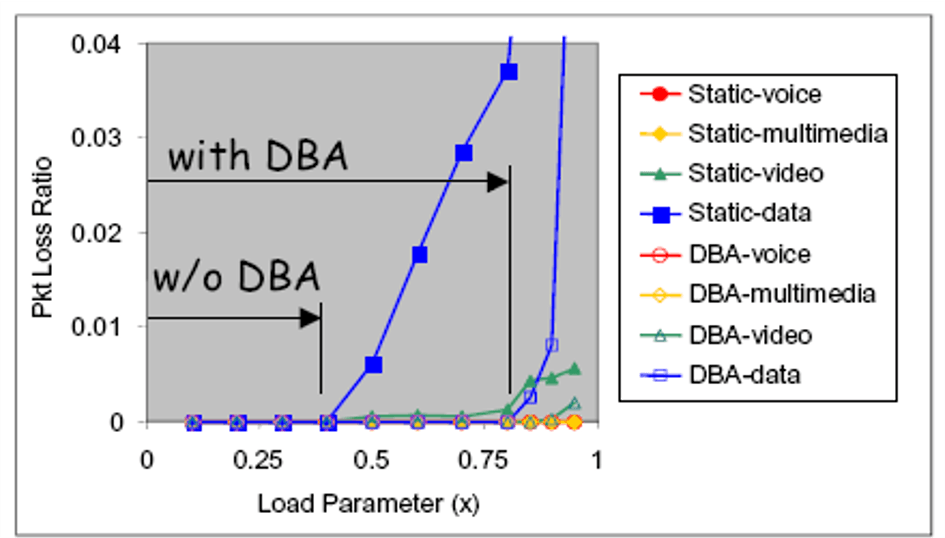
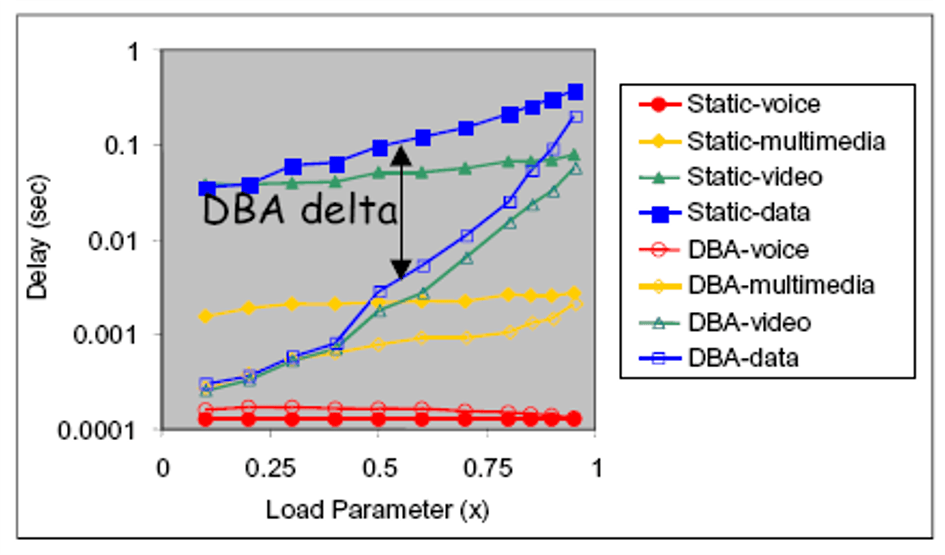
Benefits: higher PON port utilization, more users per port, better experience for bursty services (web browsing, video).
4. Four Basic T-CONT Types
| Type | Behavior |
|---|---|
| Fix | Timeslot always reserved, even if empty. For critical services like voice. |
| Assure | Guaranteed when data is ready; idle bandwidth can be shared. |
| Not Assure | Gets bandwidth only if spare is available. Higher priority than Best Effort. |
| Best Effort | Lowest priority. Gets whatever remains. |
5. DBA Templates (Type1~Type5) for Complex Needs
Four types alone are not enough. Example requirement: voice (fixed) + internet (1 Mbps assured, up to 2 Mbps max). DBA templates (combinations like Type1, Type2, etc.) provide flexible policies.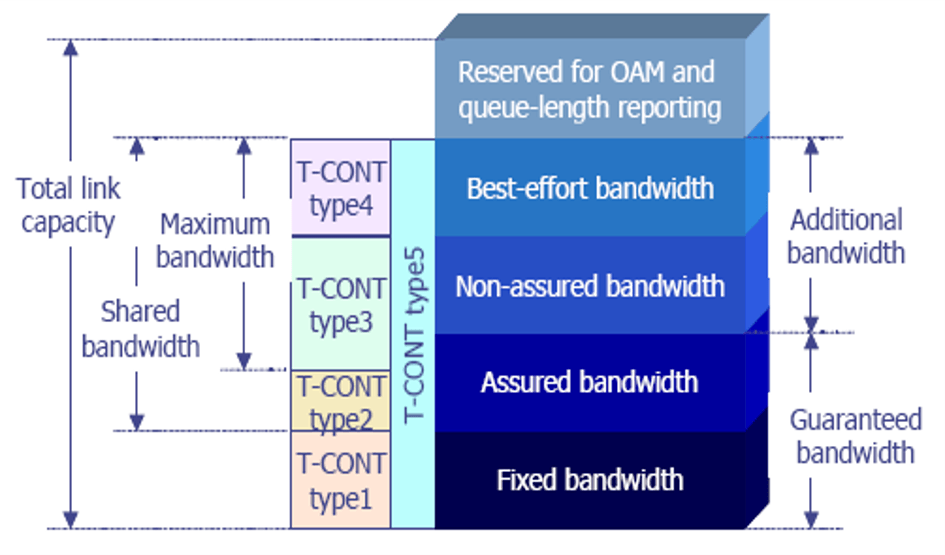
6. How DBA Works
The OLT’s DBA module continuously collects DBA reports from ONUs, performs calculations, and sends the result as a BW Map to all ONUs. Each ONU transmits upstream data strictly in its assigned timeslot – ensuring efficient, collision-free sharing.
Summary
T-CONT = logical container based on bandwidth needs, not tied to physical devices.
DBA = intelligent engine that dynamically schedules bandwidth to maximize utilization and minimize delay.
Together, they enable operators to guarantee QoS for premium services while efficiently handling best-effort traffic.
Next time you enjoy a VoIP call while downloading a large file, remember – T-CONT and DBA are working behind the scenes, giving every byte the right treatment at the right time.
 Focuscom to Showcase PON and AI Workstation Solutions at CIOE 2026
 GP5801-01 Single Port GPON OLT for Compact FTTH Networks
 XPON ONU Stick: Simplify FTTH, FTTB and FTTO Network Deployment with SFP-Based PON Access
 Demystifying GPON Architecture: What is a GEM Port and Why is it Critical for FTTH Networks?
